Silvio Luparello’s BMW
The Shape of WaterSilvio Luparello’s BMW first appears as an obstruction in the bushes and a sealed space containing a dead man; it then becomes a guide to the route taken to the Pasture. Its green body, locked doors, tire marks, and condition connect the discovery of Luparello’s body to the practical question of how the car reached its hiding place. The vehicle is not merely the setting for the discovery: its material details shape the investigation and make a concealed journey legible.
Discovery in the bushes
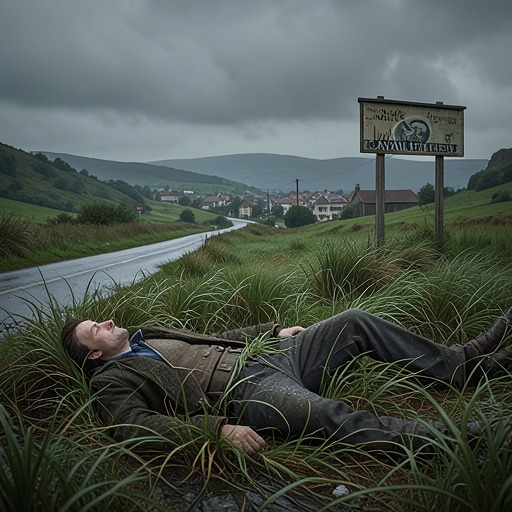
Pino, working the stretch of the Pasture nearest the beach, notices the nose of a car about twenty yards away, protruding from bushes denser than those around it. It is seven in the morning, and he doubts anyone could still be there. Approaching cautiously, he reaches the taillights and stands upright; nobody calls out, and the car seems empty. Only when he comes nearer does he distinguish a motionless man in the passenger seat, head thrown back. The appearance and smell make him suspect that something is wrong.
Pino calls Saro over. Together they approach the driver’s side, but its door is locked. The large green BMW sits so close to the shrub that they cannot get to the passenger door, against which the man is partly leaning. They lean in through the brambles, scratching themselves as they try to see his face more clearly. His eyes are open and motionless: he is dead, not asleep. The discovery makes the car’s arrangement decisive. The body’s position, the locked door, and the obstructed side shape what the two men can see and how they can approach it. Their terror is intensified by recognition: the dead man is not a stranger.
A route encoded in the car’s arrival
The BMW’s presence at the Pasture raises a geographical problem. Fazio reports that it came from Montelusa, not Vigàta. The beach on the Vigàta side is blocked by cement barriers, so the car could not simply have driven onto it from there. The alternative roads and byways between Montelusa and Vigàta might allow a driver to avoid being seen, but they do not remove the final obstacle: to reach the Pasture, the BMW would have had to cross the dry bed of the Canneto.
That route seems implausible because the riverbed is considered impassable. Fazio tests the possibility himself, driving through it and damaging his own car’s suspension. His experience establishes that crossing is possible, while also making clear that it exacts a mechanical cost. The BMW’s route is therefore more than a line on a map: the terrain imposes a physical test, and the vehicle’s ability to negotiate it becomes part of the account investigators must establish.
Fazio also identifies tire tracks where the BMW left the riverbed and turned onto the sand. He proposes that the tracks be cast before they disappear or are disturbed. This detail gives the vehicle a second evidentiary role. Its passage has left a trace outside the car itself, at the precise transition from the riverbed to the beach. The BMW can be followed not only through its location and condition but through the marks it has impressed on the ground.
Condition and reconstruction
Later, Salvo Montalbano drives the BMW along the shore and confirms that it is working properly, with nothing broken. That observation sits in pointed contrast to Fazio’s damaged suspension: the riverbed is difficult, but the BMW appears to have come through the relevant stretch without visible damage. The contrast makes the car’s condition an investigative fact rather than incidental description. It invites comparison between what the route demands and what this particular vehicle shows after taking it.
Ingrid takes the wheel when Montalbano says he is in too much pain to drive. She explains that anyone could drive down that stretch; the skill lies in bringing the car through it in the same condition in which it started. Her account adds a practical sequence to the route: after a beach crossing, the driver might reach a paved road and need to accelerate to recover lost time. The undamaged BMW and the tracks at the riverbed’s exit thus belong to the same problem of movement, not separate observations. The route tests a driver’s control, and the car preserves evidence of how successfully that test was met.
Narrative function
The BMW links the body’s discovery to the reconstruction of the journey. At first, its concealment among the bushes and its inaccessible passenger side restrict what Pino and Saro can know; later, its point of origin, the unavoidable crossing, and the tire tracks offer investigators ways to reason backward from the scene. Its doors and position regulate access, its tires register contact with the ground, and its working condition bears on the difficulty of the journey. These ordinary mechanical facts acquire narrative force because they constrain explanations: the car cannot be treated as if it simply appeared at the Pasture.
The vehicle also connects different forms of knowledge. Fazio tests the riverbed directly and reports the cost to his own suspension; Montalbano checks the BMW on the shore; Ingrid distinguishes merely driving over the stretch from doing so without damaging the car. Together, these observations shift attention from the dead man alone to the means by which he arrived. The BMW remains a car, but its material condition and route make it an active part of the investigation: a sealed container at the scene, a witness to a difficult passage, and a record whose details can be examined.